Never expose the Docker socket: Traefik up front, an SSH tunnel for all access

The Docker socket grants de facto root access to whatever machine exposes it. This post describes the pattern I set up to let a reverse proxy discover the containers on a remote Docker host without ever exposing that socket on the network: a point-to-point SSH tunnel, paired with a proxy that filters the API itself.
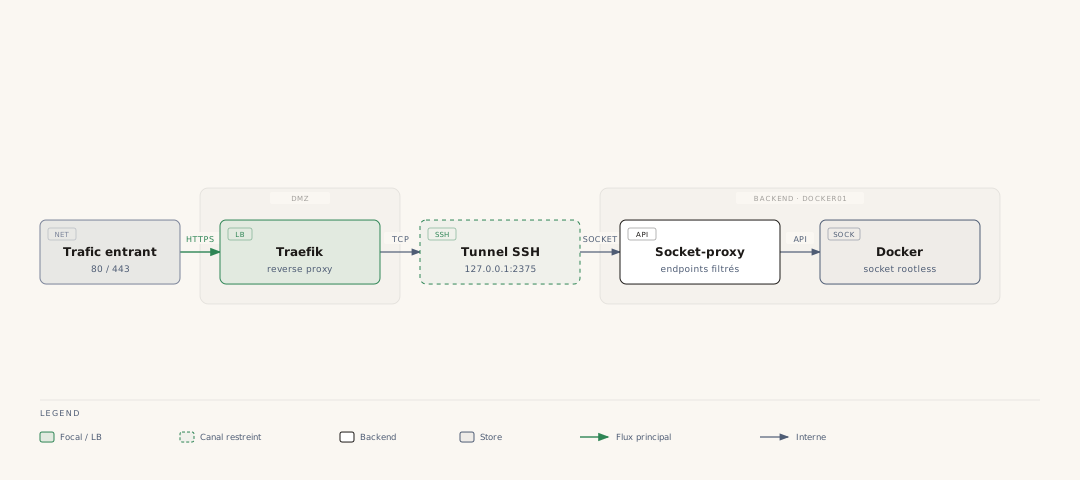
Why the Docker socket is a network problem, not just a permissions problem
Access to the Docker socket (/var/run/docker.sock) lets you launch a container with any mount you want, including the host's root filesystem, read-write. It's root access in disguise. Exposing it on the network, even behind TLS authentication, expands an attack surface that has no reason to exist: the only legitimate consumer here is the reverse proxy, which just needs to discover active containers to route traffic to them, not create any, not mount anything on them.
The architecture: two hosts, one role each, a tunnel between them
I split the role across two hosts:
- An "edge" host, running the reverse proxy (Traefik) and receiving all incoming traffic on 80/443.
- A "backend" host, running the application containers on rootless Docker, and never listening directly on the network for the Docker API.
The link between the two is an SSH tunnel I set up via a dedicated service account, forwarding a local port on the edge (127.0.0.1:2375) to the remote Docker socket.
# On the edge side, set up by the traefikd service account
autossh -M 0 -N \
-L 127.0.0.1:2375:/var/run/docker.sock \
-o ServerAliveInterval=15 -o ServerAliveCountMax=3 \
Traefik, configured with Network=host on its Podman Quadlet unit, can then talk to the backend's Docker API as if it were local: with not a single byte crossing the network in the clear, and no Docker port ever opened toward the outside of the backend.
# traefik.container (Podman Quadlet, excerpt)
[Container]
Network=host
Environment=DOCKER_HOST=tcp://127.0.0.1:2375
A second barrier: filtering the API itself
I added a second barrier because even through the tunnel, the full Docker API remains far broader than what a reverse proxy needs: it needs to list containers and networks, not create volumes or launch new containers. A socket-proxy sits between the tunnel and the real socket, and only allows the endpoints strictly necessary for service discovery:
services:
  socket-proxy:
    image: tecnativa/docker-socket-proxy:v0.5.0
    environment:
      CONTAINERS: 1
      NETWORKS: 1
      SERVICES: 0
      TASKS: 0
      POST: 0        # no writes, read-only
    volumes:
      - /var/run/docker.sock:/var/run/docker.sock:ro
    networks:
      - socket-proxy
POST: 0 forbids any write operation on the API: the proxy only lets reads through. Defense in depth: even a full compromise of the reverse proxy upstream wouldn't grant write access to Docker on the backend side, only a read-only view of existing containers and networks.
Rootless on both sides
Both hosts run Docker/Podman rootless: the daemons run under dedicated service accounts (non-root UIDs), not under root. That limits what a container escape can reach even in the event of a full compromise of an application container: the attacker inherits the service account's rights, not root on the host.
$ ps -o user,pid,cmd -C dockerd
USER       PID  CMD
dockeruser 4821 /usr/bin/dockerd-rootless.sh
The service account carrying the tunnel has exactly one right
I restricted the account that sets up the SSH tunnel to a locked-down authorized_keys entry, unable to do anything other than open that one specific tunnel:
# authorized_keys for the proxy account on docker01
restrict,permitopen="127.0.0.1:2375" ssh-ed25519 AAAA... traefikd@traefik01
restrict disables everything (command execution, agent forwarding, PTY allocation, X11 forwarding) and permitopen limits the one allowed forward to the Docker socket, nothing else. It can neither run a remote command, nor open a shell, nor forward to any other port. Same principle as the socket-proxy, applied at the SSH level rather than the HTTP level: two independent layers filtering the same edge → backend relationship, each at its own level.
Two distinct accounts coexist on the edge host: traefikd (the service account, dedicated UID, handling both the SSH tunnel and the Traefik Quadlets) and a pre-existing local traefik account (UID 1000) with no relation to the service whatsoever. Mixing them up while debugging wastes precious time chasing a permissions problem on the wrong side.
What makes this pattern applicable elsewhere
This is the point I take away the most from setting this up, and the idea goes beyond Docker: whenever a service needs to talk to a sensitive API on another machine, the question to ask is: does it need direct network access, or does a restricted tunnel suffice? An SSH tunnel with tight authorized_keys permissions, combined with an application-level filtering proxy, gives you two independent layers of control, and neither one needs to expose anything publicly for the reverse proxy to do its job.